
If you’ve seen “TW” in a caption, DM, or group chat and paused, you’re not alone. TW has several meanings, but one is by far the most common. This guide explains what TW means in text, how Gen Z uses it, and how to use or answer it without awkwardness.
Quick Answer Box
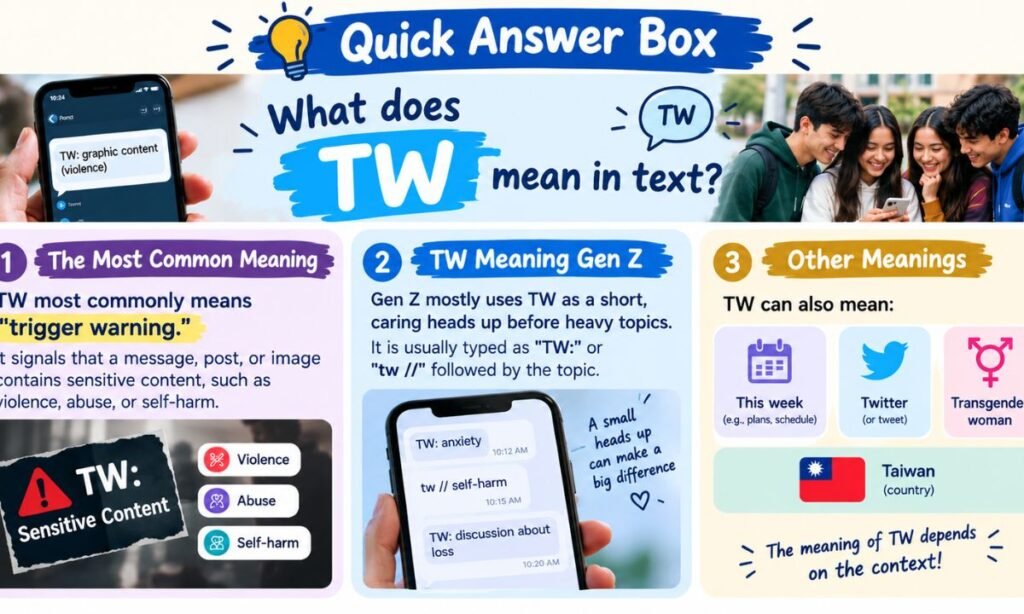
What does TW mean in text? TW most commonly means “trigger warning.” It signals that a message, post, or image contains sensitive content, such as violence, abuse, or self-harm.
TW meaning Gen Z: Gen Z mostly uses TW as a short, caring heads up before heavy topics. It is usually typed as “TW:” or “tw //” followed by the topic.
Other meanings: TW can also mean “this week,” “Twitter” or “tweet,” “transgender woman,” or “Taiwan,” depending on context.
What Does TW Mean in Text?
In most chats, TW is a label placed before content that could upset someone. It gives the reader a moment to prepare, or a chance to skip. Many top pages on this topic stay vague about this, but the dominant meaning is clear: TW = trigger warning.
Origin and Evolution of TW
The idea of a trigger warning began in online forums and feminist blogs in the early 2000s. Writers used it to warn readers about content related to trauma. The abbreviation spread through Tumblr, LiveJournal, and Twitter, where short labels were practical.
By the late 2010s, TW had moved into texting, TikTok, Instagram captions, and Discord servers. Today it is typed casually, often in lowercase, with no explanation.
Psychological and Emotional Meaning of TW
TW is about emotional safety. A person who has lived through trauma can be thrown off by an unexpected mention of it. A short warning gives them a choice: read now, read later, or skip.
Mental health professionals note that avoidance alone is not a treatment for trauma. Still, a warning is not meant to treat anything. It is a courtesy that helps people prepare. Using TW signals empathy, not weakness.
Communication Function of TW
TW works as a label. It does three jobs:
- Alerts the reader before sensitive content.
- Filters content, so people can mute or skip it.
- Signals care between friends and communities.
It also saves time. Two letters replace a full sentence like “Heads up, this message mentions something distressing.”
Also Read This:DWU Meaning in Text: Definition, Examples, and How to Use It
Cultural and Generational Context of TW
Younger users grew up online, where unexpected distressing content is common. For them, TW is basic etiquette. Older users may find it new or even unnecessary, and some people debate whether warnings help or overprotect.
Neither view is “wrong.” What matters is knowing the norm in the space you are in. Fan communities, mental health groups, and student circles tend to expect TW. Casual work chats usually do not.
Why TW Became Popular
- Social platforms let anyone post to a huge audience.
- Algorithms can surface upsetting content without notice.
- Short slang fits fast typing.
- Online communities made content labels a shared norm.
Semantic Core Meaning of TW
At its core, TW means a warning that sensitive content follows. Every common use grows from this idea: be careful, something heavy is coming. The abbreviation works as a label placed before the content.
Most Common TW Meaning in Text (Deep Dive)
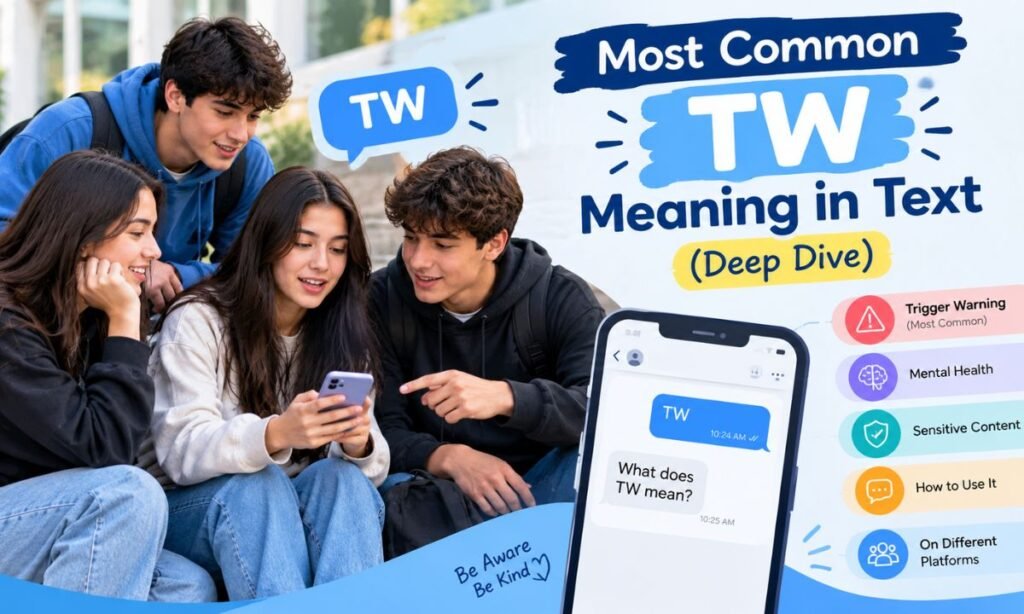
In most chats, TW = trigger warning. You will usually see it in this pattern:
- “TW: self harm”
- “tw // violence”
- “tw food talk”
The topic after TW is the useful part. A TW with no topic is less helpful, because the reader still doesn’t know what to expect.
Common TW Topics
| Category | Examples |
| Violence | Gore, war, assault |
| Mental health | Suicide, self harm, eating disorders |
| Abuse | Domestic abuse, bullying |
| Medical | Blood, needles, surgery |
| Discrimination | Racism, slurs |
Meaning Based on Context
| Context | Likely Meaning |
| Before a sensitive topic | Trigger warning |
| Social media, “see my tw” | Twitter or tweet |
| “TW I’m free” or schedule talk | This week |
| LGBTQ+ spaces | Transgender woman |
| Travel, domains, shipping | Taiwan |
The pattern is simple: if it appears before heavy content, it’s a trigger warning. Otherwise, check the surrounding words.
How TW Is Used in Real Conversations
- “tw: food. I’m so stressed about my diet lately.” The friend knows to read carefully.
- “TW for blood, the video is intense.” The viewer can choose to skip.
- “I have a test tw.” Here it likely means “this week.”
- “Check my tw for updates.” This points to a Twitter account.
TW Meaning on Different Platforms
- TikTok: Creators add TW text on screen before sensitive videos.
- Instagram: Captions and Stories often begin with “TW.”
- X (Twitter): Users put TW before threads about trauma or news.
- Discord: Servers often have rules requiring TW tags.
- Text messages: Friends use it as a quiet heads up.
- Reddit: Posts use TW or “CW” in titles.
When to Use vs When to Avoid TW
| Use TW When | Avoid TW When |
| Sharing news, stories, or images about violence or abuse | The message is harmless |
| Posting in a community that expects labels | It would confuse your audience |
| Talking about your own struggles with a friend | Everyone already knows the topic |
| Content might surprise people | You’re using it as a joke or clickbait |
Overusing TW can dilute its meaning. Keep it for content that truly warrants it.
Hidden or Risky Meanings of TW
- Misread as “this week.” A serious TW might be skipped if someone assumes it’s about scheduling.
- Used as clickbait. Some accounts add TW to attract attention. This erodes trust.
- Ambiguity with “transgender woman.” In some contexts, readers may be unsure which meaning applies.
- Too vague. “TW” alone may cause anxiety. Name the topic.
Variations and Forms of TW
- TW: the standard form.
- tw // or TW/ common on Tumblr and Discord.
- TW + topic, such as “tw: abuse.”
- Content warning (CW): a close sibling.
- Lowercase “tw”: casual and common on TikTok.
TW vs Similar Slang
| Term | Meaning | Difference |
| TW | Trigger warning | Focuses on possible trauma triggers |
| CW | Content warning | Broader, covers any sensitive material |
| NSFW | Not safe for work | About explicit or adult content |
| Spoiler | Plot reveal | About entertainment, not emotional safety |
TW and CW are often used interchangeably. Some communities prefer CW because it covers a wider range of content without implying a clinical trigger.
How to Decode the Correct Meaning
- Where did you see it? Social posts and DMs usually mean trigger warning.
- What comes right after? A topic like “violence” confirms it.
- Is it followed by a time? “TW at 5” or “TW off” suggests “this week.”
- Who sent it? A friend who talks about mental health likely means trigger warning.
- Still unsure? Just ask. A quick “TW as in trigger warning?” is fine.
How to Respond to TW
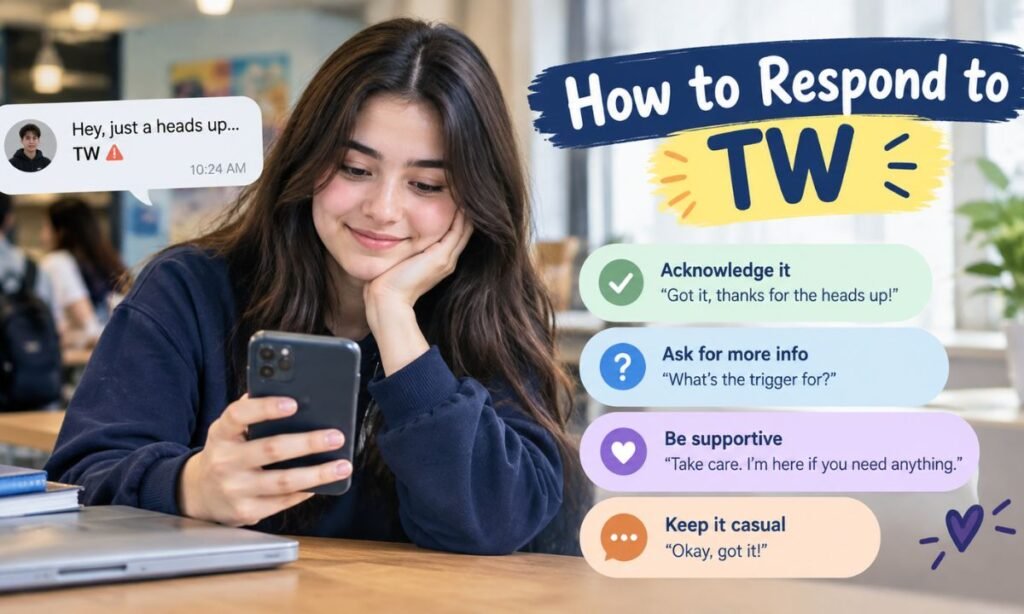
If someone sends a trigger warning:
- Thank them. “Thanks for the heads up.”
- Decide if you’re ready. It’s fine to skip or come back later.
- Check in kindly if they’re sharing something personal. “Do you want to talk about it?”
- Never mock it. Even if you don’t need warnings, others do.
Short reply examples:
- “Thanks for warning me, I’ll read it later.”
- “Got it. I’m here if you want to talk.”
Common Misunderstandings About TW
- “TW means the person is weak.” It doesn’t. It’s a courtesy.
- “TW always means trauma.” The word “trigger” is broader in use today. It can include anything distressing.
- “TW is only for mental health.” It’s also used for graphic news, medical content, and more.
- “TW and CW are identical.” Close, but CW is broader.
- “TW has one meaning only.” Context can change it.
Regional and Cultural Usage of TW
TW is strongest in English speaking online communities in the US, UK, Canada, and Australia. In other regions, people may use local equivalents or write the full phrase in their own language. In some places, “TW” may more often mean Taiwan, especially in domain names and shipping labels.
Cultural attitudes differ too. Some communities see warnings as basic respect. Others consider them unnecessary. Reading the room is the best rule.
Frequently Asked Questions
What does TW mean in text?
It usually means “trigger warning,” a heads up before sensitive content.
What does TW mean on TikTok?
Creators use it to warn viewers about upsetting topics in a video.
Is TW the same as CW?
They are similar. CW (content warning) is broader and often used for any sensitive content.
Can TW mean “this week”?
Yes. In scheduling talk, TW can mean “this week,” so check the context.
How do you write a TW correctly?
Write “TW:” followed by the specific topic, such as “TW: violence.”
Is it rude to ignore a TW?
It’s not rude to skip the content, but it is unkind to mock the warning.
Should I use TW at work?
Rarely. In professional settings, a clear sentence is better than slang.
Conclusion
TW most often means “trigger warning,” a small act of care that lets people choose how they engage with sensitive content. Other meanings exist, including “this week,” “Twitter,” and “transgender woman,” so context always matters. When you use TW, name the topic. When you see it, respond kindly.
