
DWU Meaning in Text: What It Means, How to Use It, and Examples
Got a message ending in “DWU” and not sure what it means? You are not alone. In most chats, DWU means “Don’t Wait Up.” A few other readings exist, but context usually settles it quickly.
This guide covers the meaning, the alternatives, real examples, and how to reply without confusion.
Quick Answer Box
DWU most commonly stands for “Don’t Wait Up.” The sender is telling you not to stay awake or keep waiting for them.
Less common meanings:
- Do You Want (as in “DWU grab food?”)
- Don’t Worry, You (reassurance)
- Do What You (permission, rare)
What Does DWU Mean in Text?

DWU is a texting abbreviation. It is usually typed in capitals or lowercase, often at the end of a message.
Typical examples:
- “Going out with Sam tonight, DWU.”
- “Stuck at work, dwu.”
The tone is casual and considerate. The sender wants you to go on with your evening without worrying about them.
Origin and Evolution of DWU
The phrase “don’t wait up” is old spoken English, used when someone expects to return late. Texting simply shortened it.
No major dictionary documents DWU, and no reliable source names its creator or first use. Some sites give exact dates, but those claims are not backed by verifiable evidence. It is safest to treat DWU as informal shorthand that grew out of everyday speech.
Psychological and Emotional Meaning of DWU
DWU carries care and reassurance. It tells the other person, “I know you might worry, and you don’t need to.”
It also signals independence. The sender is saying they are fine and in control of their timing.
Communication Function of DWU
DWU does three jobs in a chat:
- Sets expectations about when the sender will return or reply.
- Prevents worry by giving a heads up.
- Closes the conversation politely without a long explanation.
Cultural and Generational Context of DWU
Younger users who grew up with fast messaging apps use abbreviations the most. Parents, partners, and roommates tend to be the people who receive DWU. It fits households and relationships where someone might wait for another person to get home.
Why DWU Became Popular
- It is short and fast to type.
- The original phrase was already common, so people understood it right away.
- Messaging apps reward quick, low effort replies.
- It sounds friendly rather than blunt.
Semantic Core Meaning of DWU
At its core, DWU means release from expectation. The sender frees you from waiting, watching the clock, or checking in. Every “Don’t Wait Up” version carries that idea, whether it relates to a late night, a delayed reply, or a postponed plan.
Most Common DWU Meaning in Text (Deep Dive)
“Don’t Wait Up” works in two ways:
- Literal: Do not stay awake for me. (“Late shift tonight, DWU.”)
- Figurative: Do not hold your plans for me. (“Start the movie, DWU.”)
Some writers also stretch it to “don’t worry about me,” which is a softer version of the same idea.
Meaning Based on Context
| Context | Likely Meaning | Example |
| Late night plans | Don’t Wait Up | “Heading to the party, DWU” |
| Group event | Go ahead without me | “Order first, DWU” |
| Question at the start | Do You Want | “DWU come over later?” |
| Comforting a friend | Don’t Worry, You | “DWU, it will be fine” |
| Gaming or niche chats | Group specific slang | Ask the group |
How DWU Is Used in Real Conversations
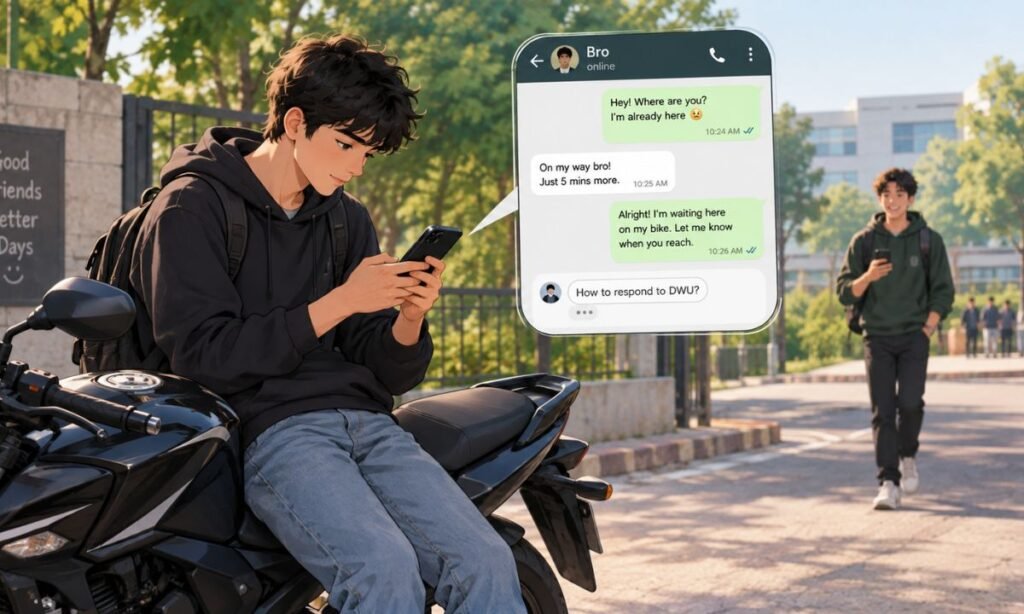
Example 1: Family
- Mom: “Are you coming home late?”
- You: “Yes, DWU.”
Example 2: Friends
- “Running behind, start without me, DWU.”
Example 3: Work chat
- “Finishing the report, DWU.”
Example 4: Question form
- “DWU a ride tomorrow?” (Do you want a ride?)
DWU Meaning on Different Platforms
| Platform | Usual Meaning | Notes |
| Don’t Wait Up | Common with family and friends | |
| Snapchat | Don’t Wait Up | Often with late night plans |
| Instagram DMs | Don’t Wait Up | Casual and quick |
| TikTok comments | Varies | Can be a reaction or niche slang |
| Work apps | Rarely used | Spell it out instead |
DWU Meaning in Text From a Girl
When a girl texts “DWU,” it usually means the same thing: Don’t Wait Up. Gender does not change the definition.
What may change is the tone:
- Friendly: She is busy and will reply later.
- Caring: She does not want you to stay up for her.
- Distant: If her replies are short and cold, it may be a polite way to end the chat.
Read the full conversation, not just the abbreviation. If you are unsure, ask her directly: “Do you mean don’t wait up?”
Also Read This:ACC Meaning in Text: What Does ACC Mean in Texting?
When to Use vs When to Avoid DWU
| Use DWU When | Avoid DWU When |
| Texting friends or family | Writing to a boss or client |
| You will be late | The message is serious |
| You want a quick heads up | The reader may not know slang |
| The chat is casual | Safety or health is involved |
Hidden or Risky Meanings of DWU
DWU has no widely accepted offensive meaning. The risks come from confusion:
- Someone may read “Don’t Worry, You” when you meant “Don’t Wait Up.”
- A partner may take it as cold or dismissive.
- A worried parent may need more detail than three letters.
If safety matters, such as when you are traveling at night, add your location or expected time.
Variations and Forms of DWU
- dwu (lowercase, most common)
- DWU! (friendly emphasis)
- dw u (spaced)
- dwu 😴 (with an emoji)
Be careful with “DW.” It usually means “Don’t Worry,” which is a different message.
DWU vs Similar Slang
| Slang | Meaning | Difference |
| DWU | Don’t Wait Up | Tells someone not to wait |
| DW | Don’t Worry | General reassurance |
| NVM | Never Mind | Cancels a request |
| BRB | Be Right Back | You are returning soon |
| TTYL | Talk To You Later | Ends a chat |
| WYD | What (are) You Doing | Asks a question |
How to Decode the Correct Meaning
Use this simple checklist:
- Check the time. Late night messages point to “Don’t Wait Up.”
- Look at placement. At the end of a message it is usually “Don’t Wait Up.” At the start of a question it may be “Do You Want.”
- Read the earlier messages. They often explain the plan.
- Consider the relationship. Family and friends use it differently than coworkers.
- Ask. A quick “DWU as in don’t wait up?” removes doubt.
How to Respond to DWU
Good replies:
- “Okay, stay safe!”
- “Got it, text me when you’re home.”
- “No worries, see you tomorrow.”
- “Alright, have fun!”
If you are unsure what it means, say so: “Do you mean don’t wait up?”
Common Misunderstandings About DWU
- Myth: DWU is an official dictionary term. Fact: It is informal slang.
- Myth: It has one fixed meaning everywhere. Fact: Context matters, and rare alternatives exist.
- Myth: It is rude. Fact: It is usually polite and caring.
- Myth: It has a documented origin story. Fact: No reliable source confirms who first used it.
Regional and Cultural Usage of DWU

The phrase “don’t wait up” is natural English, so DWU is easiest to understand among English speakers in the US, UK, and Canada. Elsewhere, people may know it through global apps like WhatsApp and Snapchat. In multilingual chats, a quick explanation helps avoid mix ups.
Frequently Asked Questions
What does DWU mean in text?
It usually means “Don’t Wait Up.”
Is DWU the same as DW?
No. DW means “Don’t Worry,” while DWU usually means “Don’t Wait Up.”
Does DWU ever mean “Do You Want”?
Sometimes, when it opens a question such as “DWU grab lunch?”
Is DWU rude?
No. It is generally polite and considerate.
Can I use DWU at work?
Avoid it in formal messages. Write “Please don’t wait for me” instead.
What does DWU mean from a girl?
The same thing: “Don’t Wait Up.” Check her tone and the conversation for extra meaning.
How do I reply to DWU?
Say “Okay, stay safe” or “Got it, talk later.”
Is DWU in the dictionary?
No major dictionary lists it. It is informal texting shorthand.
Who invented DWU?
No reliable source confirms a creator or first use.
What if I don’t understand a DWU message?
Ask the sender. A short question is better than guessing.
Conclusion
DWU most often means “Don’t Wait Up,” a friendly way to say you do not need to stay awake or hold your plans for someone. A few rare meanings exist, such as “Do You Want” or “Don’t Worry, You,” so check the time, placement, and relationship before you respond.
When the message matters, ask for clarity. Slang changes quickly, and a quick check keeps the conversation clear and kind.
